Unia tundralta
Näyttelyn teokset ovat syntyneet Jäämeren ja mieleni maisemissa. Niistä on muotoutunut unenomaisia fragmentteja maisemasta, josta ihminen on kenties kadonnut, mutta jonka kädenjälki näkyy yhä uusissa elämänmuodoissa. Teokset rakentuvat maastosta keräämistäni orgaanisista ja epäorgaanisista materiaaleista, kuten merenrannoilta löytämistäni roskista, levistä ja kasvien osista sekä hylätyistä vaatteista. Teosten kautta pohdin ihmisen osaa suuressa elonkirjossa nyt ja tulevaisuudessa.
/
Dreams from the tundra
The works in this exhibition were created in the landscapes of the Arctic Ocean and of my mind. They have taken shape as dreamlike fragments of a landscape from which humans may have disappeared, yet whose imprint is still visible in new forms of life. The works are constructed from organic and inorganic materials I have collected from the terrain, such as litter gathered from seashores, algae, plant fragments and discarded clothing. Through these works, I reflect on humanity's place within the great diversity of life, now and in the future.
All we need is empathy!?
Eläydytäänpä hetken aikaa seuraaviin tapahtumiin ja yritetään samalla tarkkailla tunteita, joita ne herättävät: Adolf Hitler leikkimässä rakkaan Blondi-koiransa kanssa. Dalai Lama nauttimassa liha-ateriaa. Vladimir Putin lapsena, nälkiintyneenä, köyhyyden ja syvällisen surun keskellä. Äiti Teresa vastaanottamassa rahalahjoitusta Haitin diktaattorilta, joka on syytettynä korruptiosta ja ihmisoikeusrikkomuksista. Tapahtumat eivät äkkiseltään tunnu todellisilta, vaikka tosia ovatkin. Näiden mielikuvien kautta tulee pohtineeksi, missä kulkee raja oikean ja väärän, hyvän ja pahan välillä? Onko ylipäätään olemassa hyvää tai pahaa ihmistä?
Teos All we need is empathy!? on toteutettu Suomen armeijan entiseen ammusvarastoon, Örön saarelle. Pieni saari on ollut sotilaskäytössä ja suljettuna yleisöltä Venäjän vallan ajoista lähtien, aina vuoteen 2015 asti. Teos koostuu valtioiden, kansallisuuksien ja moniarvoisuutta symboloivien lippujen osista. Ne limittyvät ja sekoittuvat toinen toisiinsa valonsäteen muodossa. Teoksen lähtökohtana on ollut itse ammusvarasto, historiallisena rakennuksena, sekä sen käyttötarkoitus. Teoksen nimi toimii yhtä aikaa kehotteena ja kysymyksenä: voisimmeko alkaa suhtautua toisiimme ja itseemme lähtökohtaisesti empaattisesti!? Ajallemme on tyypillistä polarisoida toisiamme, vaikka pohjimmiltamme olemme ihmisinä hyvin samanlaisia, samoine tarpeinemme ja toiveinemme. Tahtoisimmeko kohdata toisemme tasa-arvoisina ihmisyksilöinä kansallisuudesta, sukupuolesta, seksuaalisesta suuntautumisesta, ideologioista, statuksesta tai mistään muustakaan genrestä riippumatta?
Kysymys pohdittavaksi: järkkyisikö maailman rauha, jos alkaisimme ajatella ja toimia sen ajatuksen pohjalta, että fyysisiä tai käsitteellisiä rajoja ei olisikaan ihmisten välillä?
/
Let's immerse ourselves for a moment in the following events and, at the same time, try to observe the emotions they evoke: Adolf Hitler playing with his beloved dog Blondi. Dalai Lama enjoying a meat-based meal. Vladimir Putin as a child, starving, surrounded by poverty and profound sorrow. Mother Teresa receiving a monetary donation from a Haitian dictator accused of corruption and human rights violations. At first glance, these events do not feel real, even though they are true. Through these images, one begins to reflect on where the boundary between right and wrong, good and evil, lies. Does a completely good or completely evil person even exist?
In the spring of 2024, I created a work titled All we need is empathy!? on the island of Örö. The island had been used for military purposes and closed to the public since the time of Russian rule, up until 2015. I spent a month on the island working on the piece. It was exhibited in an old ammunition storage building and consisted of fragments of national flags and flags symbolizing diversity and pluralism. These overlapped and blended into one another in the form of a beam of light. The starting point for the work was the ammunition depot itself, as a historical building, and its intended purpose. At the same time that I was sewing the piece on the shoreline rocks, the military was conducting exercises. Large vessels cruised along the horizon.
The title of the work functions simultaneously as a call to action and a question: could we begin to approach one another—and ourselves—with empathy as a starting point!? It is characteristic of our time to polarize one another, even though, at our core, we are remarkably similar as human beings, sharing the same needs and hopes. Through the work, I seek to raise the question of whether we would be willing to meet one another as equal human individuals, regardless of nationality, gender, sexual orientation, ideology, status, or any other category.
A question for reflection: would world peace be shaken if we began to think and act on the idea that there were no physical or conceptual boundaries between people?
Varjoja paratiisissa
Kun ihminen lensi avaruuteen tutkiakseen Kuuta ja muita taivaankappaleita, tuli hän katsoneeksi Maata ulkoapäin. Ja mitä hän näkikään; kauneimman kuviteltavissa olevan luomuksen, paratiisin, joka leijuu loputtoman suuressa, alati laajenevassa avaruudessa. Ihminen havahtui ymmärtämään, että kaikki mitä maapallolla on, on yhtä elävää, hengittävää ja äärimmäisen haavoittuvaa olentoa.
Käsityksemme paratiisista tuntuisi kytkeytyvän jonkinlaiseen luonnontilaiseen ympäristöön, jossa on täydelliset olosuhteet elämälle: puhdasta ilmaa ja vettä, metsiä, eri eläinlajien kirjo, ruokaa, ihmisiä sopivassa suhteessa muuhun luontoon nähden. Ajatus paratiisista liittyisi siis voimakkaasti maahan. Sanaan maa sisältyy paljon; maa on olemassaolomme perusta, ajateltakoon sitä maailmankaikkeuden planeettana tai maan pintana. Maa antaa voiman kaikelle kasvavalle ja ottaa haltuunsa kuolevan. Kuolleesta aineesta syntyy jotakin uutta, elävää.
Olen kerännyt kotini lähimetsistä, pelloilta ja joen rannoilta ihmisen jättämiä roskia. Usein jätteet ovat alkaneet hajota osaksi ekosysteemiä. Mieleen nousee kysymyksiä: Mitä syntyy öljytynnyreistä ja muoviroskasta? Missä kulkee raja luonnollisen ja luonnottoman välillä? Maahan sotkeutuneet autonrenkaat ja muovijäte kulkeutuu kasveihin, joidenka ansiosta pystymme ylipäätään hengittämään. Ravinnon, hengittämämme ilman sekä veden kautta jäte jatkaa kiertoaan; elämän mystinen sykli. Teoksissani olen liittänyt jätteet osaksi omaa mielenmaisemaani, jossa niiden energia muuntuu joksikin muuksi kuin pelkäksi saasteeksi. Teosteni osana ne ehkä herättävät kysymyksiä suhteestamme Maahan, kotiimme, itseemme. On hyvä visualisoida mielessä, että Maa jota asutamme ja hyödynnämme, on vain meillä lainassa tulevilta sukupolvilta.
/
Shadows in Paradise
When humanity flew into space to explore the Moon and other celestial bodies, it also looked back at Earth from the outside. And what did it see? The most beautiful creation imaginable—a paradise floating in the endlessly vast, ever-expanding universe. Humanity awoke to the realization that everything on Earth forms one living, breathing, and extremely vulnerable being.
Our conception of paradise seems to be connected to some kind of natural environment where the conditions for life are perfect: clean air and water, forests, a diversity of animal species, food, and humans existing in a balanced relationship with the rest of nature. The idea of paradise would therefore be strongly linked to the earth. The word earth contains much within it; it is the foundation of our existence, whether we think of it as a planet in the universe or as the ground beneath our feet. The earth gives strength to all that grows and takes possession of all that dies. From dead matter, something new and living is born.
I have collected litter left behind by people from the forests, fields, and riverbanks near my home. Often, the waste has already begun to decompose and become part of the ecosystem. Questions come to mind: What is created from oil barrels and plastic waste? Where is the boundary between the natural and the unnatural? Car tires and plastic debris entangled with the soil make their way into plants, thanks to which we are able to breathe at all. Through food, the air we breathe, and water, the waste continues its cycle—the mysterious cycle of life. In my works, I have incorporated waste into my own inner landscape, where its energy is transformed into something other than mere pollution. As part of my artworks, it may raise questions about our relationship with Earth, our home, and ourselves. It is worth visualizing that the Earth we inhabit and utilize is only on loan to us from future generations.
Miten historiaa luetaan?
Työhuoneeni seinällä on kuva 11-vuotiaan Margit Koretzovan maalaamasta vesivärityöstä. Siinä on kuvattuna aurinko, perhosia, kukkia ja toukka. Maalaus on tehty Terezinin keskitysleirillä vuonna 1944. Kuva puhuu minulle enemmän, kuin kaikki se virallinen teksti, mikä on päätynyt historiankirjoihin luettavaksi. Sen sijaan että ihmettelisin voittoja ja tappioita, minulle merkityksellistä on katsoa kuvaa, jossa pieni ihminen kiteyttää jotakin tavattoman olennaista elämästä.
Samalla kun taloudellinen ja henkinen taantuma nakertaa elämäämme, tuntuu tarpeelliselta palata peruskysymyksen äärelle: mitä perustavaa laatua olevaa ja elämän jatkumisen kannalta olennaista tapahtuu sillä välin, kun ihmiskunta kipuilee talouskasvun ja hyödyn maksimoinnin kanssa? Ihmiset juoksevat onnensa perässä, yrittäen saada elämälleen täydellisen hinta-laatu-suhteen. On hirveä kiire johonkin - parempaan tulevaisuuteenko? Mieleni tekee luoda jonkinlainen vastaliike kaikelle tälle, olla tiukasti kiinni tässä hetkessä.
Teos nimeltä Miten historiaa luetaan? pyrkii kommentoimaan sitä, kuinka ihminen arvottaa omaa olemassaoloaan ja kuinka se rinnastuu muuhun elolliseen toimintaan maapallolla. Teoksen lähtökohtana on omakohtainen kokemukseni siitä, kuinka yksittäinen, katoava hetki on usein korvaamaton suhteessa johonkin sellaiseen, minkä tarkoituksena on olla kategorisoitava ja pysyväisluontoinen. Tässä teoksessa olen yhdistänyt oman työpanokseni mehiläisten tekemään työhön, joka konkretisoituu teoksen materiaalissa, mehiläisvahassa. Teosta varten valoin vuoden ajan mehiläisvahasta A4- kokoisia, paperinohuita arkkeja. Arkkeihin tallentui siis vuoden työni sekä mehiläisten työ, tosin huomattavasti pidemmältä ajanjaksolta. Sulatin teoksen näyttelyni viimeisenä päivänä ja palautin vahan mehiläisten käyttöön. Teos oli konkreettisesti olemassa vain näyttelyn ajan, jonka jälkeen se ehkä on jatkanut hetken olemassaoloaan näyttelyvieraan muistissa.
/
How history can be read?
On the wall of my study hangs a copy of a watercolor painted by 11-year-old Margit Koretzova. It represents the sun, butterflies, flowers and a larva. She painted the picture at the Terezin concentration camp in 1944. That painting says to me more than all the formal writings in the history books. Instead of thinking about the victories and defeats, the most important thing to me is to look at the picture in which a little human being crystallizes something extremely significant about the life.
At the same time when the economical and mental depression gnaws our lives, it is necessary to return to the basic issues: what kind of fundamental things, crucial to our survival, are happening at the same time as humankind is in agony over the economic growth and profit maximization? People are chasing their fortune, trying to achieve the perfect quality-price ratio of their life. A terrible rush somewhere – maybe to a better future? Therefore, I wanted to create a countermove to all that, and firmly seize the moment.
This work of mine, How history can be read? makes comments on the value we give to our existence and how our life here harmonizes with other ways of existing on the earth. The basis for this work was my personal experience of the irreplaceableness of an occasional passing moment in relation to something very categorizing and permanent of its nature. In this piece of art I have combined my own labor to the labor of bees, which becomes tangible in the material of the work, beeswax. For one year's time I casted paper-thin A4-size sheets of beeswax, storing in them my contribution and the input of bees from a considerably longer time-period. On the last day of the exhibition, I melted the artwork and returned the wax back to the bees. This work existed concretely only during the exhibition, and afterwards maybe for a moment in the visitors' memory.
Valloittajan merkintöjä, 2.painos
Teos nimeltä Valloittajan merkintöjä, 2. painos, koostuu tuhansista, yhteen liitetyistä historiankirjojen hakemistoista. Teos laskeutuu katosta lattialle, muodostaen tilaan dyynimäisiä harjanteita. Osaan hakemistoista on hioutunut reikiä ja osasta teksti on kadonnut kokonaan. Ne näyttävät jääneen olosuhteiden armoille – hiekka ja tuuli ovat kuluttaneet sisältöjä näkymättömiin.
Teoksen äärellä saattaa herätä kysymys siitä, mitä historiankirjoihin onkaan tallentuneena? Onko niin sanottua kaikkien yhteistä historiankirjoitusta loppujen
lopuksi edes olemassa? Historiankirjoitus lienee pääsääntöisesti aina voittajien sanelemaa, mikä väistämättä tekee siitä hyvin tulkinnanvaraista. Voittajana taas voidaan kai pitää sitä, joka tekee merkintönsä viimeisenä. Teos antaakin viitteitä siitä, että tässä tapauksessa luonto on kirjannut viimeiset merkinnät ihmisen historiaan; kuvitteellinen hiekkamyrsky on hionut pois ajanjaksoja, jättäen jälkeensä ainoastaan riekaleita ihmiskunnan muistista ja saavutuksista.
/
Notes of an Invader, 2nd edition
This artwork, called "Notes of an Invader, 2nd edition", is composed of thousands, attached to each other, index pages of history books. The artwork pours down from the ceiling on the floor, forming dune-like ridges in the room. Many of the indexes are worn out and have become holey; from some pages texts have disappeared. They apparently were left at the mercy of harsh conditions – sand and wind have worn the contents out of sight.
By this piece of art a question may arise – what has been recorded in the history books? Does a shared, collective conception of history even exist? Historiography is always mainly dictated by the winners, which inevitably makes it very ambiguous and open to interpretations. The winner is the one who makes his notes lastly. This artwork indicates that in this case nature has made the last notes in the man's history; a sandstorm has ground out entire epochs and left behind only shreds of humankind's memory and achievements.
Fata Morgana
Fata Morganalla tarkoitetaan kangastusilmiötä. Se saa kaukaiset kohteet näkymään muualla kuin ne todellisuudessa ovat. Itse kohtasin yhden Fata Morganan Jäämerellä ollessani; taivaanrannassa leijui jäävuori.
Ihmiset ovat saavuttaneet melko järjettömiä asioita pyrkiessään tavoittelemaan onnea vallan, rikkauksien ja kunnian kautta; rajoja on piirretty uudelleen, ennätyksiä rukattu ja koko maailmankuva on kirjoitettu moneen kertaan uuteen asuun. Myös mahdottomilta tuntuvat asiat ovat toteutuneet ihmisen matkalla kohti tuntematonta onnen maata. Onnen tavoittelu näyttäisi ajavan ihmisiä liikkeelle.
Silloin tällöin saatamme havahtua onnen ja vallan tavoittelun huumassa näkemään ponnistelujen huvittavuuden ja järjettömyydenkin. Näennäisen järkeviltä tuntuvat tavoitteet usein vain korostavat ihmisen toiminnan mielettömyyttä. Uudet päämäärät ottavat aina paikkansa, valta vaihtuu ja historia kirjoitetaan uuteen uskoon. Onni väreilee kangastuksen tavoin saavuttamattomana taivaanrannassa.
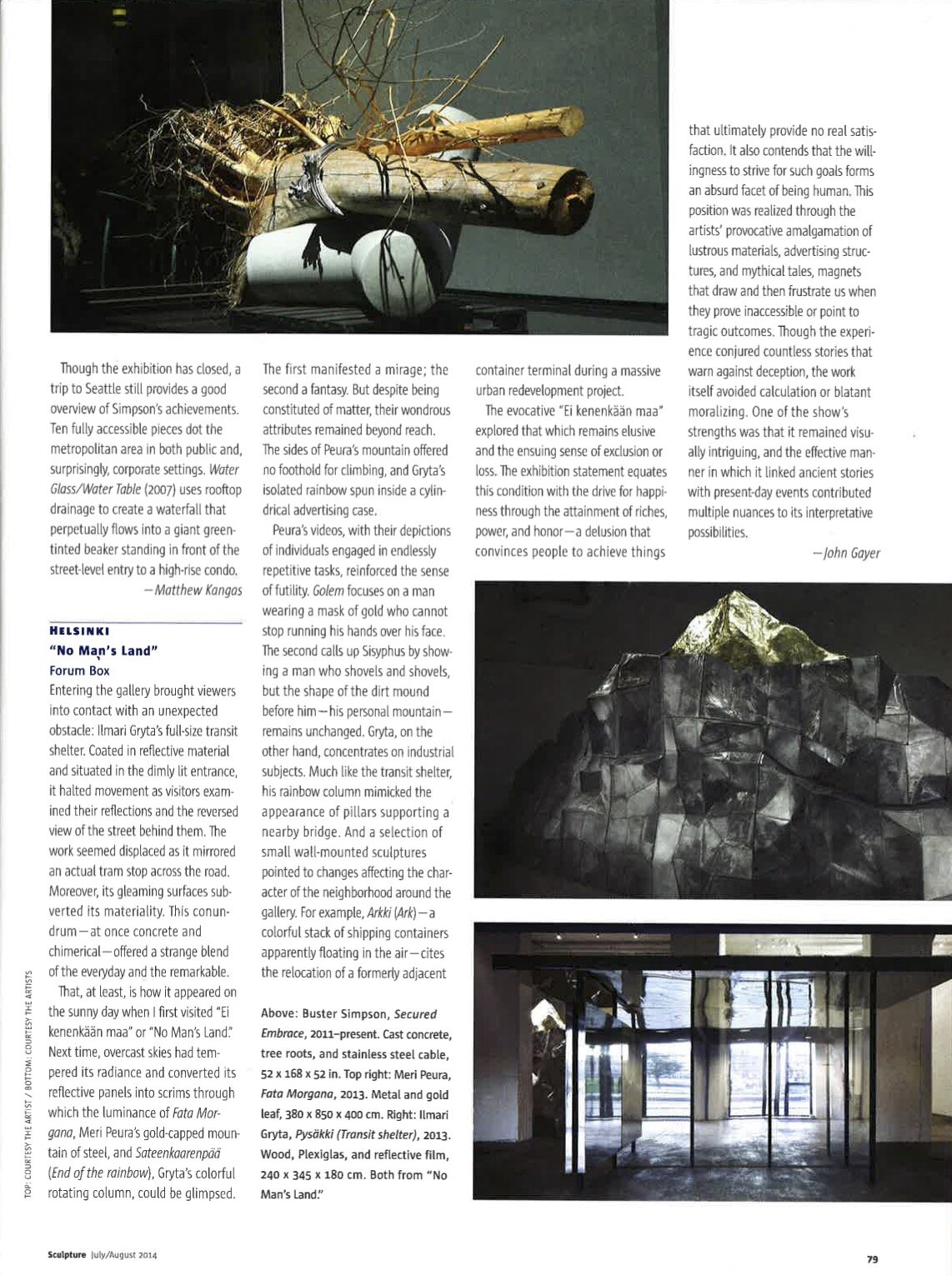
Teos nimeltä Fata Morgana on jäävuorta muistuttava rakennelma, materiaaleina pelti, metalli ja kulta. Rakensin teosta kaksi vuotta, ilman varsinaista päämäärää. En ollut varma, saisinko teosta koskaan valmiiksi, eikä sillä oikeastaan tuntunut olevan merkitystäkään. En tiennyt sitäkään, mitä valmiissa teoksessa pitäisi olla nähtävissä. Ainoana motiivina aloittaa työ, oli purkaa surua, jota teinkin hakkaamalla peltiä. Kultasin vuoren huipun - se tuntui korostavan sopivalla tavalla tekemiseni näennäistä mielettömyyttä. Teosta tehdessä oivalsin kuitenkin jotakin mielestäni perustavaa laatua olevaa elämästä; ponnisteluillamme ei ole loppua, ja jokainen hetki on pysymätön. Tämä käsillä oleva hetki on ainut todellinen asia, ainut todellisuus. Oivallettuani tämän huomasin, että suru oli kadonnut. Työnikin sai merkityksen, siinä sivussa.
/
Fata Morgana
Fata Morgana is a mirage phenomenon, which makes distant objects show elsewhere than where they really locate. I encountered myself a Fata Morgana on the Arctic Ocean; an iceberg was floating above the horizon.
People have achieved quite senseless things when trying to reach happiness through power, riches and glory; borders have been re-drawn, records faked, and the whole worldview many times re-written into a new guise. Also, seemingly impossible things have come true when man has wandered towards the paradise unknown. Pursuit of happiness seems to drive people forward.
Once in a while in the frenzy of our chases we may awake to see the ridiculousness and absurdity of our efforts. Outwardly reasonable targets often just emphasize the insanity of man's acts. New goals replace the old ones, old powers will be changed, and the history rewritten. The unreachable fortune always flickers in the horizon like a mirage.
The artwork, named Fata Morgana, is a construction resembling an iceberg. Materials are tin plate, metal and gold. I messed around the work for two years, without a definite purpose. I was not sure if I ever would finish the work, and it actually didn't seem to have any importance. I didn't even know what the final piece should look like. My only motive was just to get started, and unload my sorrow of that time, which I really managed to do by hammering the plate. I gilded the iceberg's top – it seemed to emphasize the apparent absurdity of my work in an adequate way.
When I was working with this piece, I felt I realized something fundamental about life: our efforts have no end, and every moment is impermanent. This very moment is the only thing that exists, the only reality. With this idea, I noticed my sorrow had vanished. Moreover, on the side, my work found a meaning.
Planeetan arkisto
Teos nimeltä Planeetan arkisto voisi olla eräänlainen kuviteltu jäänne ihmiskunnasta. Teos on suurta arkistokaappia muistuttava rakennelma, jonka arkistot ovat jäässä. Sen sisään on jäädytetty, kenties, ihmiskunnan muisti. Arkistot ovat jäässä, jotta ne säilyisivät mahdollisimman kauas tulevaisuuteen. Samalla arkisto on kuitenkin reliikki, jonka sisällöllä ei ole minkäänlaista merkitystä tai tehtävää enää siinä vaiheessa, jos ihminen katoaa maapallolta. Suurin osa arkiston laatikoista on avattu. Niiden sisällöt ovat sulaneet ja kadonneet. Muistista on poistettu ajanjaksoja joko vahingossa tai tarkoituksella. Vielä jäässä olevat laatikot reagoivat ympäröiviin olosuhteisiin. Ne kasvattavat hiljalleen jääkerrosta sisällään, riippuen ilmankosteudesta ja lämpötilan vaihtelusta. Jääkerrokset saattavat myös alkaa sulaa ilmanalan lämmetessä. Teoksen kanssa samassa tilassa olevien ihmisten hengitysilma tiivistyy arkistolaatikoiden pintoihin vedeksi ja pikkuhiljaa jääksi.
/
The Planet's Archive
This artwork, called The Planet's Archive, could be a kind of an imaginary relic of the humankind. It shows a construction resembling a huge file cabinet containing frozen records. Inside, perhaps, lies frozen the memory of the humankind. The archive has been frozen with the purpose of conserving it to the far-off future. At the same time, it is a relic, which bears no meaning or function anymore if man has disappeared from the planet. Some of the drawers have been opened, and the contents melted and vanished. Entire periods of time have been deleted from the memory, by chance or on purpose. Those still frozen react to the surrounding conditions; they slowly increase the ice-layer within, depending on the air humidity and temperature changes. The ice may also start melting when the climate warms up. The air that people in the same space breathe out condenses on the surface of the file drawers into water, and then ice.
Sculpture Magazine, July/August 2014